Renting vs Buying a Home: What Makes Financial Sense in 2026
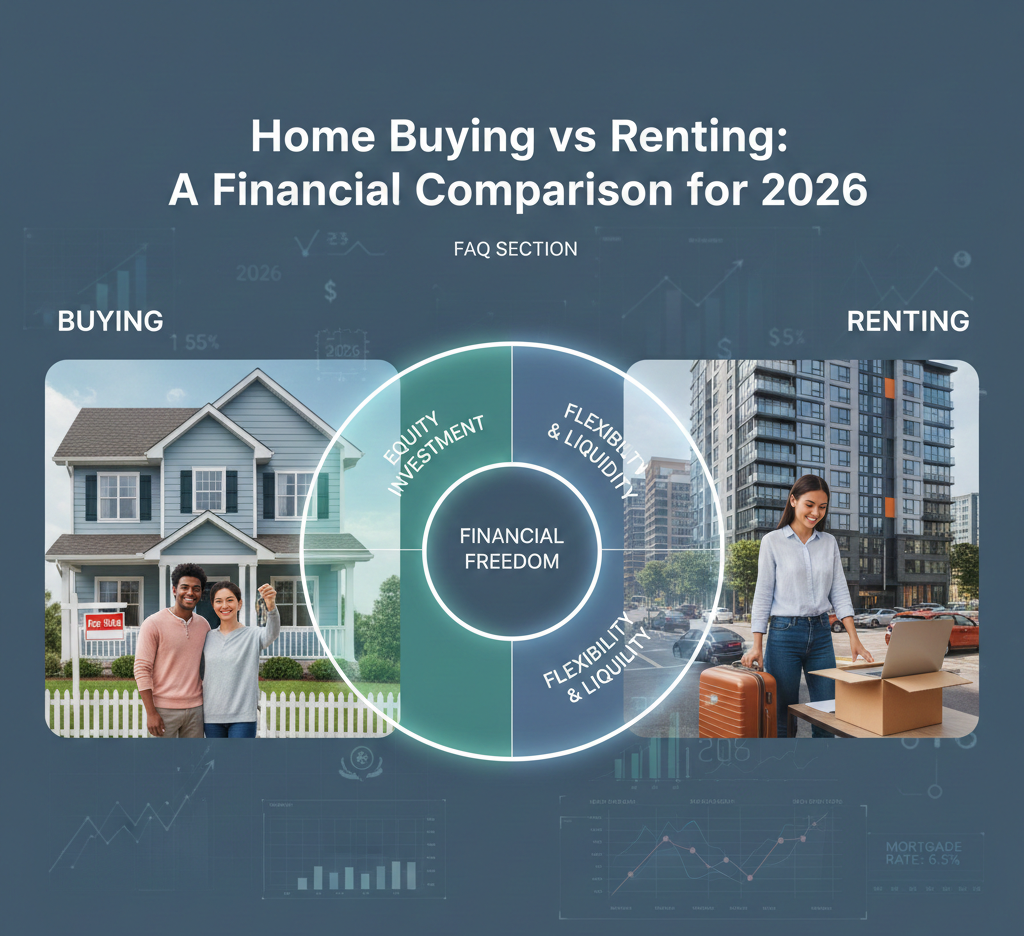
Every family gathering eventually lands on this question, doesn’t it? Someone brings up how “rent is just throwing money away,” and someone else mentions a cousin who bought at the wrong time and regretted it for a decade. The truth about renting vs buying a home is far less dramatic than either camp makes it sound — it depends heavily on your specific numbers, city, and life stage. In 2026, with interest rates and property prices both shifting compared to a few years back, this comparison genuinely needs fresh numbers, not old assumptions. Let’s look at it honestly.
Why the Old Advice Doesn’t Always Apply Anymore
“Buying is always better long-term” was common wisdom for a generation that saw property prices rise steadily for decades. That pattern isn’t guaranteed to repeat everywhere, and it never applied equally across cities anyway.
I’ve noticed people treat this as a moral choice — buying as “responsible,” renting as “wasting money” — rather than what it actually is: a financial decision that depends on your specific numbers and how long you plan to stay put.
H3: Factors That Actually Change the Answer
- How long you realistically plan to stay in one city or property
- The gap between local rent and EMI for an equivalent property
- Your down payment size and how it would otherwise be invested
- Job stability and how tied you are to a specific location
The Real Cost Comparison: EMI vs Rent
Direct answer: In most major Indian cities in 2026, monthly EMI on a home loan runs 30-50% higher than equivalent rent for a comparable property, meaning renting vs buying a home often favors renting in the short term, purely on monthly cash flow.
For a ₹80 lakh flat with a 20% down payment, a 20-year loan at current rates puts EMI somewhere around ₹55,000-60,000 monthly. The same flat might rent for ₹28,000-35,000 in many cities. That gap matters, especially early on when most of your EMI is going toward interest rather than principal.
- Compare EMI against rent for the exact same type of property, not a smaller rental versus a larger purchase
- Factor in maintenance charges, property tax, and repairs that owners bear but renters typically don’t
- Remember EMI is fixed for years, while rent typically rises 5-10% annually with each renewal
- Consider that early EMI payments are mostly interest, so equity builds slower than people assume in the first several years
The Down Payment Opportunity Cost
Here’s a factor a lot of “buying is better” arguments conveniently skip. That down payment — often ₹15-25 lakh or more — could be invested elsewhere instead of locked into a property.
- Calculate what that down payment could return if invested in equity mutual funds or index funds over the same period
- Compare that projected return against the property’s likely appreciation in your specific city and locality
- Factor in that real estate is illiquid — you can’t partially sell a flat if you need cash urgently
- Remember property appreciation isn’t guaranteed uniformly; location matters enormously, and some areas have seen flat or declining prices in real terms
Has this ever happened to you — someone confidently claims property “always appreciates,” without accounting for the opportunity cost of what that same money could have earned elsewhere?
How Long You Plan to Stay Matters More Than People Think
Direct answer: As a general rule of thumb, buying tends to make more financial sense if you plan to stay in the same home for 7+ years, since transaction costs (stamp duty, registration, brokerage) take time to offset through equity building and avoided rent increases.
- Under 3-4 years: renting almost always makes more financial sense given transaction costs on both entry and exit
- 5-7 years: it’s genuinely close, and depends heavily on local rent-to-price ratios
- 7+ years: buying starts to look more favorable as equity builds and rent increases compound over time
- Career-related relocation likelihood should weigh heavily here — a probable job move in 3 years changes the math considerably
Picture a small business owner in Jaipur who’s confident they’ll stay in the same city for the next decade, running their shop from a fixed location. That certainty tilts the equation toward buying far more than it would for someone in a role with frequent relocations.
Hidden Costs Buyers Often Underestimate
Buying involves more than just the EMI, and this is where budgets often go sideways for first-time buyers.
- Stamp duty and registration typically run 5-8% of property value depending on the state
- Society maintenance charges, which renters usually don’t pay directly
- Property tax, an annual cost owners bear that renters don’t factor into their side of the comparison
- Repairs and upkeep, which fall entirely on owners rather than landlords once you’ve bought
When Renting Genuinely Makes More Sense
Renting isn’t just a fallback for people who “can’t afford” to buy — for a lot of situations, it’s the smarter financial choice, full stop.
- Uncertain career trajectory with likely relocations within a few years
- Preference for flexibility over long-term commitment to one property or city
- Higher-return investment opportunities available for the money that would otherwise go toward a down payment
- Markets where rent-to-price ratios are unfavorable for buyers, common in some premium metro localities
When Buying Tends to Make More Sense
On the flip side, certain situations do tip clearly toward buying, beyond just emotional preference.
- Strong long-term certainty about staying in one city or locality
- Access to lower interest rates through employer tie-ups or specific loan schemes
- A locality with genuinely strong appreciation potential based on infrastructure development
- Desire for stability and the ability to renovate or modify a space without landlord restrictions
FAQ: Renting vs Buying a Home Questions
Is it always financially better to buy than rent long-term? Not always — it depends heavily on how long you stay, local rent-to-price ratios, and what alternative returns your down payment could generate if invested instead.
How do I calculate whether buying makes sense for my specific situation? Compare EMI plus ownership costs against rent for an equivalent property, factor in your down payment’s opportunity cost, and consider how long you realistically plan to stay.
Does renting really mean “wasting money” compared to buying? Not necessarily. Renting provides flexibility and frees up capital that could earn returns elsewhere, which isn’t waste, it’s a different allocation of resources.
What’s the break-even point between renting and buying? Generally 7+ years of staying in the same property, though this varies significantly by city and specific rent-to-price ratios.
Should I wait for property prices to drop before buying? Timing the market perfectly is genuinely difficult; focus more on your personal readiness, stability, and long-term plans than trying to predict short-term price movements.
Is a bigger down payment always better when buying? Not automatically — a larger down payment reduces EMI and interest paid, but it also means less capital available for other investments or emergencies.
Final Thoughts
The renting vs buying a home decision genuinely comes down to your specific numbers and life circumstances, not a universal rule either camp likes to claim. Run your own comparison — EMI versus rent, down payment opportunity cost, and how long you realistically plan to stay — before deciding. There’s no shame in renting if the numbers favor it, and no rush to buy just because it feels like the “responsible” choice. Do the math for your own situation before committing either way.
Suggested image alt text:
- “Family comparing renting vs buying a home financial calculations”
- “House keys and calculator representing home buying decision”
- “Apartment building representing rental housing option in India”